
Several years ago, I once sat in an airplane, on a homeward-bound flight to Amsterdam Schiphol Airport. The man in the window seat next to me was a first-time visitor to the Netherlands. As the plane descended towards the airport, and the landscape below became more and more visible, he looked out of the window and said: ‘Oh my goodness! That is the biggest pool table I ever saw in my life!!’ This little anecdote suffices to make the point that, yes, the Netherlands are largely a flat country. And green, obviously.
The low-lying aspect of the country is actually embedded in the name, with ‘nether’ being late medieval English for ‘low’. Please note that the Netherlands is plural: the Low Countries. At the time the name was given, it also applied to the western part of Flanders.
There is a lot more to say about the Low Countries being so low, indeed. And I might very well do so in the next blog post. But for now, it was merely an introduction to the topic of this month’s post: the numbered grid networks that we have in this country. Because, obviously, this flat character of the Dutch landscape makes it very suitable for walking and cycling.
More Bikes than People
The latter even to the extent that we have more bikes than people. According to the statistics office of the Dutch government, the Netherlands are the number one country in the world when it comes to cycling. Our population of somewhat over 18 million people shares roughly 23 million bicycles. Because many people have one for sports and one for transport. Some jokes in the expat literature about the Dutch people have it that we are actually ‘born on two wheels’.
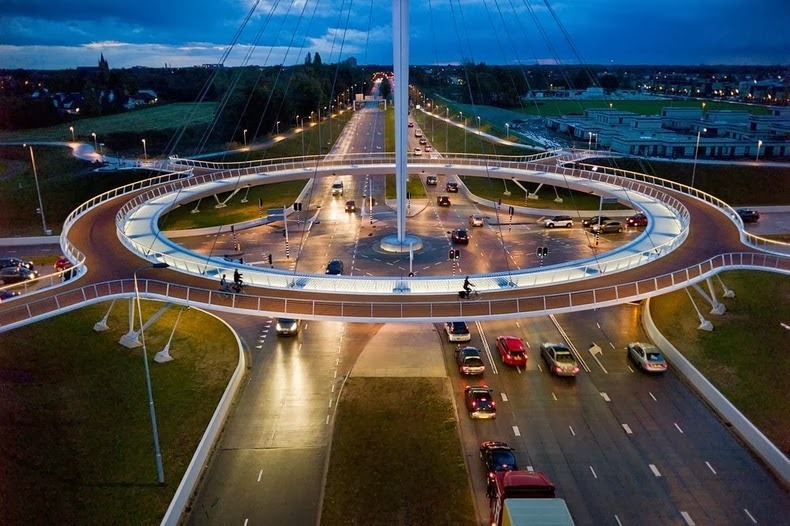
Bicycles fulfil more than one-quarter of the overall transport needs in the country. Many visiting internationals are heavily impressed by our bicycle infrastructure. The Netherlands boasts a finely meshed network featuring 35,000 kilometres of (fast) bicycle tracks to go from A to B, but also for recreational purposes, with the nearby ‘Hovenring’, which almost seems to be floating in mid-air, among the more spectacular examples.
Cycling Infrastructure
Now that springtime is here, and the weather is shaping-up: if you are looking for a nice activity, whilst simultaneously getting to know the Eindhoven area better, the network of so called ‘numbered grid points’ (‘knooppunten’) in the Netherlands, may just be your thing. And the grid networks may also provide you with an excellent activity that you can perform in a small group. Nice for some exercise and some team building.
There are now numbered grid networks for cyclists, for walkers and here and there also for horseback riders, kayaks and inline-skaters. As far as I could trace back, the grid networks once started in the 80’s of the previous century for cyclists, in the Belgian province of Limburg, in the wake of the closure of the coal mines there. With the goal of bringing nature and (the often unemployed sitting at home) miners closer together. And to lure the latter to get out of the lazy chair and move.
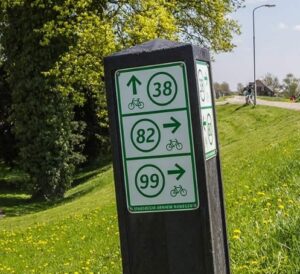
The initiative was a great success and has now spread over several countries. In addition to Belgium, for example, over the Netherlands, in Germany and in Denmark. I can assure you: it’s a pleasure! With an app (there are several of them) or a route map, you map out a route and then just cycle or walk.
The routes are often a bit longer than the ‘usual’ ones, but there’s a big benefit in return, because they take you through the most beautiful landscapes where possible and via the less-trafficked routes. And anyway, you often cycle or walk the longest route from A to A anyways. But that’s what it’s all about.
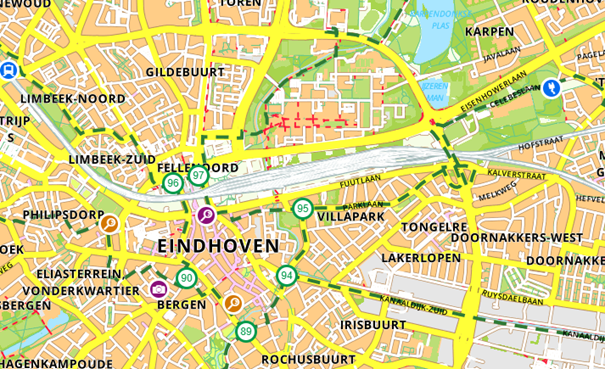
You can pick up the regional network at many places in Eindhoven, and move in any direction from there, all the way into Belgium or Germany, should you desire so. As an example: some grid points near Eindhoven central train station:
Several apps (Like Routiq or Fietsknoop) can help you design your own routes, save them and navigate them from your smartphone. Or you just write down a bunch of numbers on a sheet of paper, obviously 😉. Google Maps is more or less OK-ish for bikes, but does not yet take the (complete) grid network into account. Plus, it has a tendency to make you take car-only roads at times.
If you do use your phone for navigation, make sure to have a fixed holder for your phone on your bike, as in the Netherlands (for good safety reasons!), you can get a spicy fine for cycling while simultaneously holding your phone in your hand.
If you get enthusiastic and start riding longer tours, having a little power pack with you can come in handy, as the GPS navigation comes with a relatively heavy battery use of your phone.
Example of a Trip
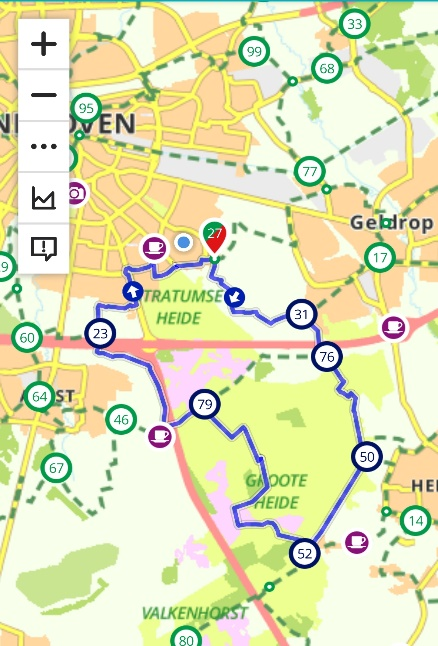
Last winter, I took a little trip south of Eindhoven. Just 21 kilometres, to manage your expectations.
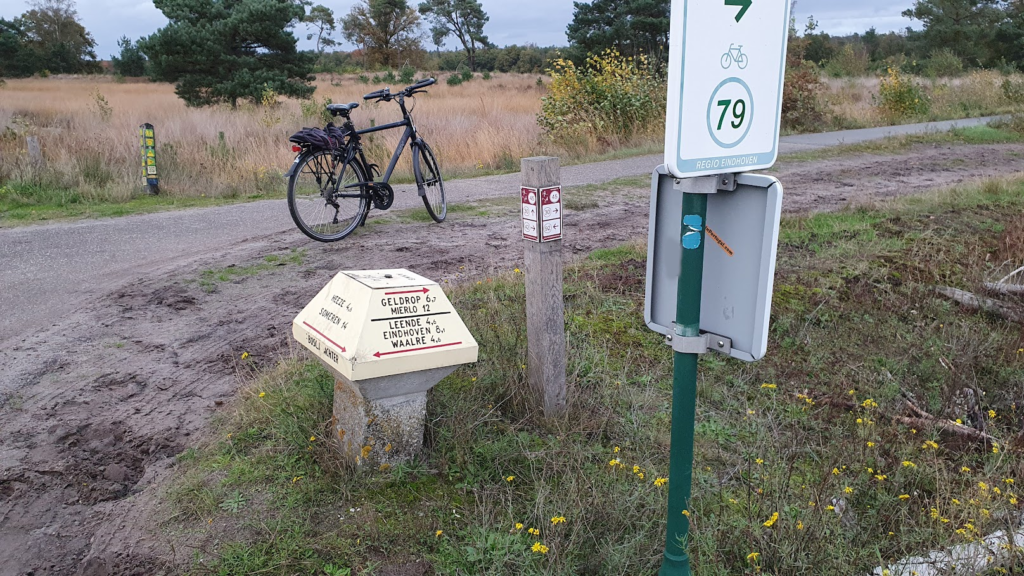
And at an intersection between grid points 52 and 79 in the route above is a point where you can see all the different grid routes come together: for walking, for cycling and for horseback riding:
The “Mushrooms” in the Countryside
If you’d like to take a less detailed approach and just like to cycle from village to village, you can also follow what the Dutch call the ‘paddestoelen’, after their shape (literally ‘toad seats’, in other words mushrooms) that guide you from place to place. Usually, you only find them in the countryside, not in the cities. They are much older than the grid networks.
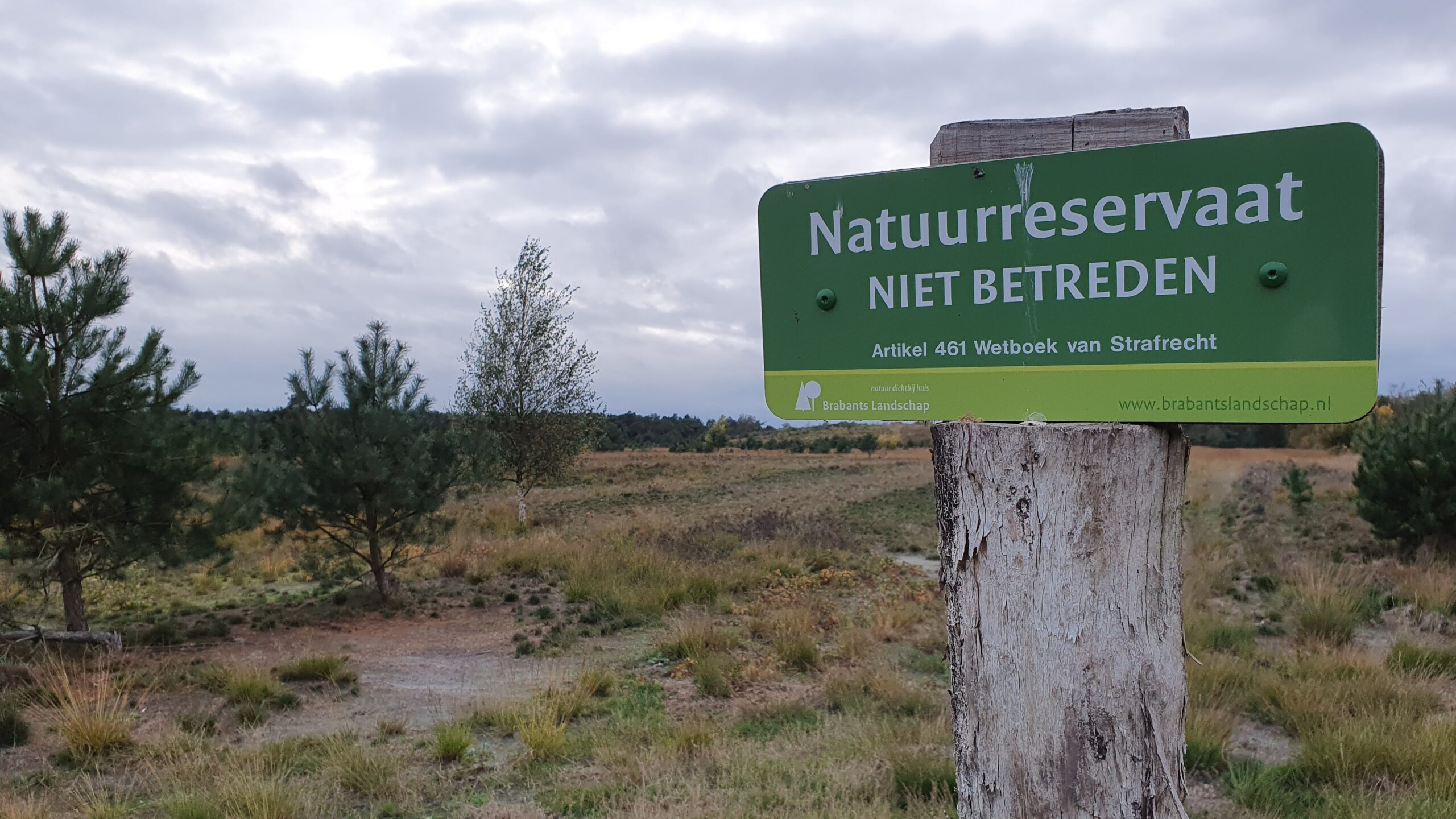
Just one more thing. Sometimes a particular sign tells you that an area of land is closed-off for visitors, because it is a nature preservation area. I found a sign like that near the same intersection. Sometimes such a sign has a particular period of the year at the bottom of it (like the months of the birds’ breeding season). If it doesn’t, like the one shown here, it applies all year.
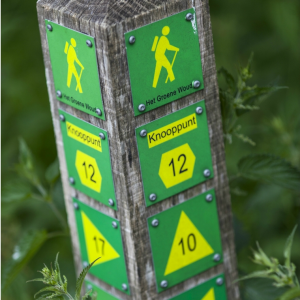
Grid Points for Walkers
I have not been able to find info for the walking grid network in English. If you want to practice your Dutch or use a translator, this site can get you started walking, though.
Enjoy your ride and/or your walk!
