
This is an updated version of an earlier blog. It also intends to draw your attention to a very attractive Dutch train ticket that is available during June and July 2026 (see the ‘Nice to Know’ section for more information).
Once an international friend suggested ‘Trains in the Netherlands’ as a topic for a blog post. As a frequent commuter by train, she’d be interested to learn more about Dutch trains. Being a frequent train traveller myself, I was happy to comply.
Before we dive into the topic of the Dutch trains and railways, let me make a little observation. In the eyes of my international friends, the Dutch have one of the most efficient public transport systems in the world. Having said that: complaining about its punctuality is presumably the second national pastime over here, after complaining about the weather. How shall I put it? The Dutch nurture high expectations, when it comes to punctuality (see an older post, The Dutch and Time, October 2021).
A Bit of Background
The first railway line in the Netherlands dates from the year 1839. On September 20th of that year the steam-powered locomotive ‘De Arend’ (the Eagle) pulled 9 railway carriages from Amsterdam to Haarlem, as a newspaper report from that time described it: “At the dazzling speed of no less than 40 kilometres per hour”!
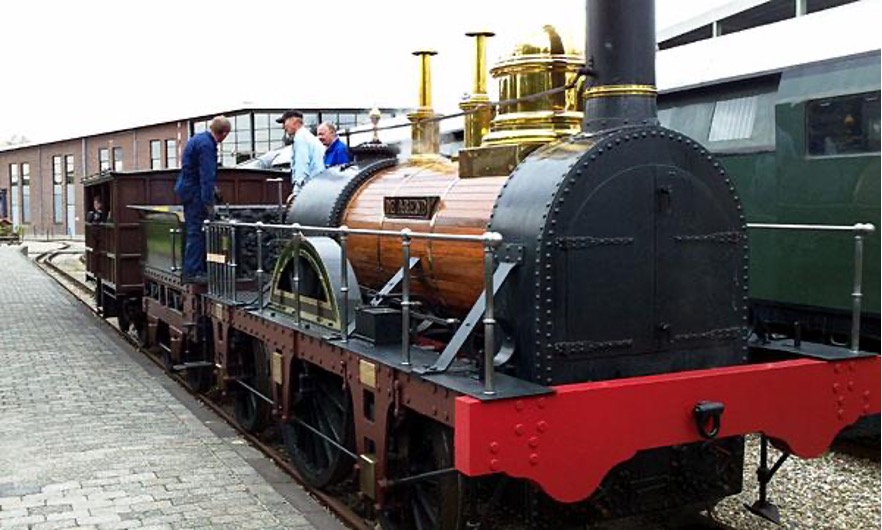
A replica of the 1839 steam-powered locomotive De Arend (the Eagle), which pulled the first train ever in the Netherlands. It is on display in the Dutch National Railway Museum.
From Private to Government to (sort of) Private Again
In the beginning, the building of different railway lines in the Netherlands was mainly a private initiative. The Dutch government only took a modest role. Over time that changed, however. Gradually all railway lines came into the hands of one government controlled company, De NS, or Nederlandse Spoorwegen (‘The Dutch Railways’).
In the 1990’s NS many regional lines were opened-up for other railway companies to exploit. Those of you who regularly travel the country by train may be aware that, for several regional lines, you have to check-out with NS, and then check-in again with another company (Arriva, Blauwnet, Conexxion, et cetera).
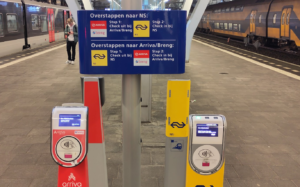
Changing between the main (NS) net and a regional line.
Nicknames
Throughout the years, many Dutch train types have been given (nick)names. Sometimes by the public, often by Dutch Railway staff members themselves. Animal names in particular are popular. We have already seen the first locomotive, De Arend (the Eagle). Here are some other examples:
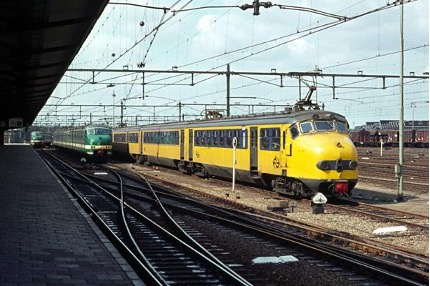
De Hondekop
In service from 1954 to 1996, these trains were nicknamed 'de Hondekop' (the dog's head).
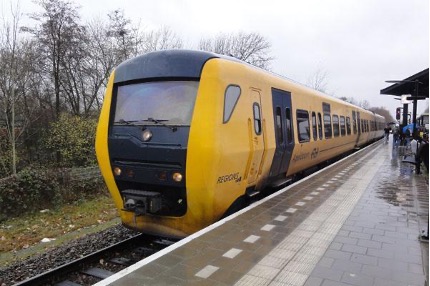
De Buffel
This (diesel powered) train is nicknamed 'De Buffel' (the Buffalo).
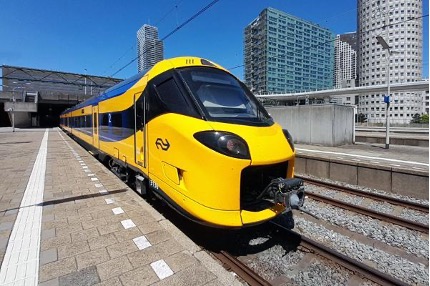
De Wesp
The latest model of Dutch intercity trains, (introduced in 1923). Nicknamed 'De Wesp' (the Wasp).
Electrification
The Dutch Railways were comparatively early in switching from steam-powered trains to electrifying their railway network. Already in 1908, the first electrified line came into use. Currently, only some regional lines are not yet electrified. It is worth mentioning here that a couple of years ago, the Dutch Railways made a major arrangement with a large electricity provider, as a result of which all Dutch (electric) trains are 100% wind powered. So by using the train in the Netherlands, you travel with only a minimal carbon footprint.
Some Food for Number Crunchers
The width of the Dutch railway tracks is 1435 millimetres, the so-called ‘Standard gauge‘. The entire length of the Dutch railway network is 3,289 kilometres, along which you can currently find 404 railway stations. At those stations, 415,000 cups of coffee are served per week, 2,400 luggage lockers await you, and over 27,000 public transport bikes are available (which together in 2025 accounted for almost 6 million rides). On an average working day 1,1 million passengers in the Netherlands travel by train.
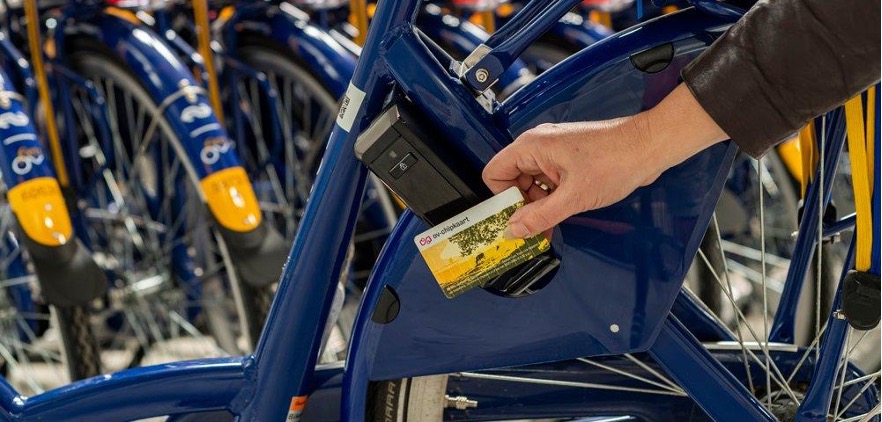
‘OV Bikes‘ (OV = ‘Openbaar Vervoer’, Public Transport).
Nice to Knows
Below are a bunch of ‘Nice to Knows´ about train travel in the Netherlands.
OV Chipcard
There is a card available for the Dutch public transport system, the so-called OV Chipkaart. It works in all trains, buses, trams and subways. You buy the card separately, so not with NS.
You can put credit on that card in machines at railway stations and elsewhere, or you can arrange for credit to be put on the card automatically if you get below a certain amount of credit. Or even to be billed once a month for all your OV travel costs. You can also use that card to unlock an OV bike.
Alternative check-in method
Increasingly (but not everywhere yet), you can check in with the Dutch public transport using your debit or credit card, or your phone. An option that I would mainly recommend to infrequent travellers, moreover, since the many discounts I am about to mention below are not available through that check-in option. Gradually, the OV Chipkaart will be replaced by a new system (OV Pay).
A variety of discounts
NS has a variety of discounts available (‘season tickets’), also for non-frequent travellers, especially if you can travel outside the rush hours. For an overview of all the options, see this page.
If you get yourself one of the NS Flex subscriptions, and connect your OV Chipcard number to your ‘My NS’ account, you can opt to pay your combined travel costs (so also bus trips, etc) monthly afterwards.
Big discount during summer 2026!
Please note: in July and August 2026, to help ease the effects of the current high fuel prices, NS offers its ‘Dalvrij subscription’ (travel with almost any train in the country, as long as you check in during off-peak hours) for only €49 per month. For conditions and how to order, see this page. If ordered before June 30th, this applies for two months. If ordered in July for one month.
Into Europe
The international service, NS International, will be happy to take you on a trip to Europe.
NS app
NS Railways has a very comprehensive app available. It not only helps you plan your trip, but it can also inform you about any delays, about facilities available at your destination station (like onward bus connections, the number of bikes available, the stores and so on). And yes, the NS app does speak English, if you want it to.
Railway Museum
Last, but not least: you made it this far in this extra-long blog post. That might suggest you have ‘something with trains’. If you do, the Dutch National Railway Museum, in the city of Utrecht, is guaranteed to offer you and yours a very nice day out, while simultaneously experiencing the entire history of the Dutch railways in real size.
You can actually go to the Railway Museum with a dedicated train from Utrecht Central Station. Plan your trip to the final destination ‘Station Utrecht Maliebaan’, and the train will take you right into the museum. As a preparation, you can already make that 14-minute train ride online. But then seen through the eyes of the train driver.
I wish you pleasant train travel. And a happy museum visit!
All the pictures of trains in this post come from the website ‘Langs de Rails‘ (alongside the tracks). Thank you, Nico Spilt, for your kind permission to use them here.
